
Book Consultation
A significant transition will occur in regard to how taxes are managed by Indian enterprises. The GST Invoice Management System (IMS) will undergo a development and mandatory migration beginning in October 2025, which represents a significant development and will enhance accuracy and transparency throughout the process. The IMS aims to create unmatched flexibility; moreover, it addresses critical business challenges, particularly with respect to Input Tax Credit (ITC) management and buyer-supplier reconciliation.
Previously, the GST portal’s ‘Accept’ or ‘Reject’ choices were too forgiving for businesses; for instance, they compelled you to make decisions hastily, potentially leading to incorrect outcomes. The upgrade to the IMS offers well-deserved flexibility in regards to actions on additional types of documents -
Why it is important to your business: This additional feature provides comfort that you can mark something as Pending (CN) without having to make an irreversible decision in a hurry. Now you can take your time to mark the Credit Note as Pending until you verify the goods were returned and confirm whether you want to claim it or reverse the ITC.
A major pain point in GST reconciliation has always been the communication gap between buyers and suppliers. If a supplier either rejected or left an invoice or credit note pending, the supplier often had no idea why which initiated the long email threads, delayed adjustments of ITC and continuous back and forth phone calls.
The new IMS update (effective October 2025) is addressing this issue directly by making it mandatory for a recipient to provide remarks every time a recipient:
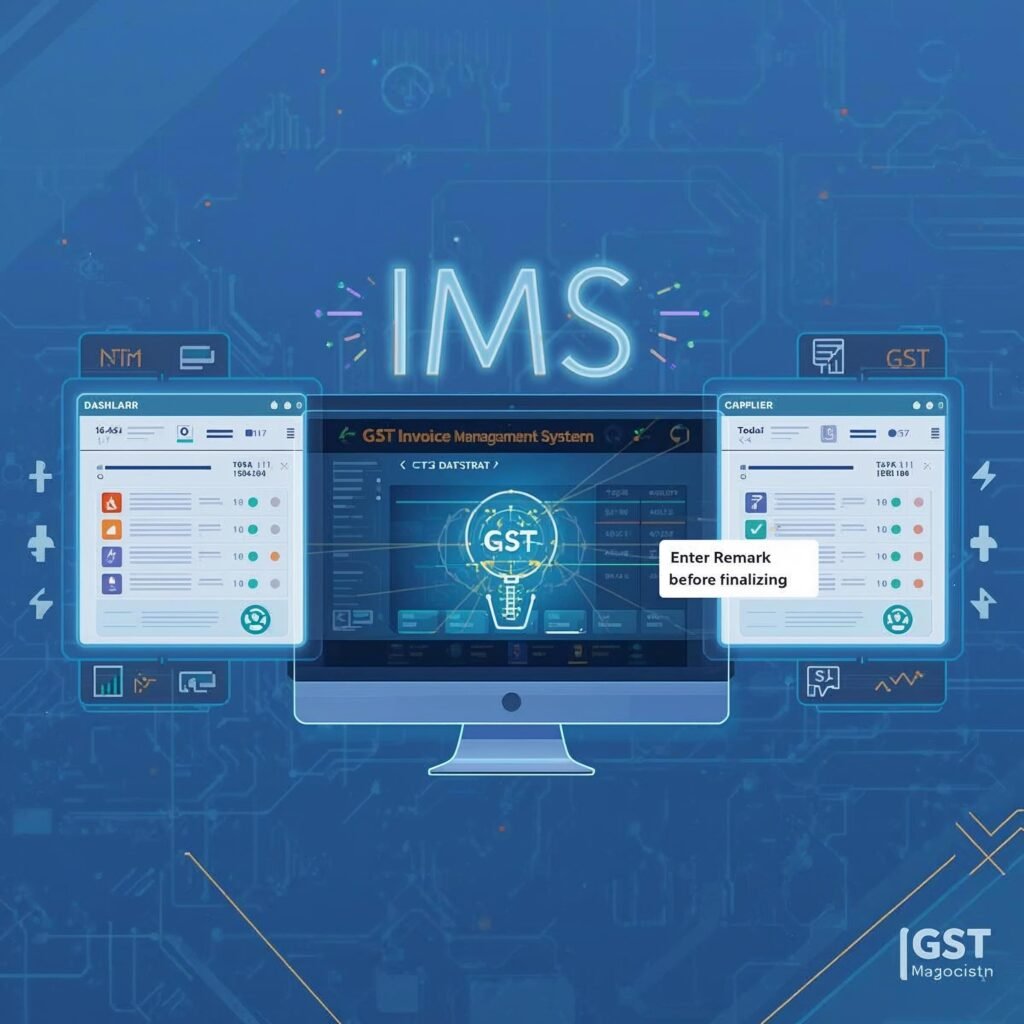
The GST portal will prompt the user to enter a brief remark before finalizing either action. The remark will be instantaneously available to the buyer and supplier on their IMS dashboards.
Both parties know exactly why an invoice or note was rejected or left pending; there is no more guessing, and clarification no longer requires back-and-forth communication.
The suppliers can instantly correct or re-issue the document based on the visible remark, which reduces the dispute cycle from weeks to days.
The remark constitutes part of the document history saved in the GST system, providing a digital trail to facilitate compliance review and audit workflows.
Buyers can rest assured knowing their Input Tax Credit (ITC) will be allowed or put on hold; the status, and reason or reasons are clearly documented on both sides.
Because remarks are visible to both users, it facilitates a culture of accuracy, ownership, and problem-solving in every transaction.
It is very important to note that the new IMS features do not apply to prior transactions. Your organization will be working in a dual system for a period of time:
| Document Type | Date of Document | System Rule Followed |
| New Regime | October 2025 or later | Pending option, partial ITC reversal, etc. |
| Old Regime | Before October 2025 | Previous rules (no pending, mandatory full ITC reversal, etc.) |
Be sure your accounting software and internal processes are immediately able to accommodate the simultaneous existence of both "old" regime documents and "new" regime documents. Your team must accurately identify the date prior to processing any document.
Clarifying Flexible ITC Reversal – A More Intelligent, Proportionate Approach
Beginning October 2025, IMS goes live with Flexible ITC Reversal. This amendment closes the gap between a CN issuance and the recipient’s ITC claim, while promoting flexibility, accuracy, and fairness in GST compliance.
In the previous GST regime (before Oct 2025), a recipient reversing a Credit Note had to reverse the entire ITC linked to that invoice, regardless of what ITC they had actually claimed.
Too much ITC has been reversed, manual reconciliation proves problematic, and buyers and sellers engage in unnecessary disputes.
Example:
A purchaser received an invoice with ₹18,000 GST, and, for various internal accounting reasons, had only claimed ₹10,000 initially. Then, the supplier issued a Credit Note for ₹9,000 GST.The original recipient would reverse ₹9,000 of qualified ITC, even though only half of it was applicable.
With the updated IMS, taxpayers have the flexibility to choose a full or partial ITC reversal depending on their actual ITC claim.
When a Credit Note is issued and a reversal occurs, the IMS asks the recipient the following direct question:
"Do you want to reduce ITC for this record?"
Most likely, the next action will be as follows:
If yes, you are able to enter the exact amount of ITC amount and reduce it for that record - there will be no assumptions of any kind and no obligation of full reversal.
If no, the ITC will remain unchanged - until you choose to manually edit it at additional time (if at all).
This change gives businesses "control" to confirm that the ITC reversal is the same as what their real book entries are - not the assumptions of the ITC reversal from the system.
| Feature | Old System (Pre-Oct 2025) | New System (Post-Oct 2025) | Compliance Impact |
| Reversal Amount | Full ITC reversal on original invoice/debit entry linked to Credit Note. | Partial or full reversal can be selected by the recipient. | Prevents over-reversal; aligns reversal with actual ITC claimed. |
| System Prompt | System assumed full reversal; manual correction required. | System prompts with “Do you want to reduce ITC for this record?” | Improves accuracy, reduces reconciliation disputes. |
| User Action | No flexibility – automatic or full reversal expected. | ‘Yes/No’ choice + editable reversal field. | Flexibility ensures book-level accuracy and smoother audits. |
Let’s say:
Supplier issues an invoice for ₹1,00,000 + ₹18,000 GST.
The recipient claims ₹10,000 ITC initially due to an internal error; consequently, we must conduct further verification to reconcile the figure with supporting documentation.
Later, the supplier issues a Credit Note reducing the value by ₹50,000 plus ₹9,000 GST; thereafter, the adjustment should be reflected in the records and reconciled with supporting documentation.
Now:
Old System: The recipient would have to reverse the entire ₹9,000, even though only ₹10,000 ITC was ever claimed.
New System (Post-Oct 2025): The system asks whether the recipient wants to reverse ITC.
Recipient selects ‘Yes’ and enters ₹5,000 — half of their originally claimed ₹10,000 ITC.
This ensures perfect alignment between the supplier’s CN and the recipient’s ITC records.
The GST Network (GSTN) has added a new table — Table 6A1 — in the Annual Return (Form GSTR-9)
for FY 2025–26 onward for better clarity and accountability of Input Tax Credit (ITC) in one's GST
return.
The new table aims to give you a complete overview of your ITC movement throughout the financial
year with complete transparency with your books, GSTR-3B, and GSTR-2B.
This is your claimed ITC in total in GSTR-3B for the financial year as at the end of the period.
For example, if the claimed ITC of the year across return(s) comes out to be ₹5,00,000, the amount would appear here. Furthermore, you can verify the figure against your records, and if there is a discrepancy, you can initiate a reconciliation.
The statement covers scenarios in which ITC was reversed for ineligibility: the recipient did not match the invoice, the vendor was not paid within 180 days, or reversal occurred for any other compliance reason.
For example, you claimed ₹5,00,000 but later reversed ₹50,000 for unmatched invoices.
This is the net ITC after reversals, which was eligible, and utilized against tax liability.
Final actual ITC utilized = ₹4,50,000 (Claimed - Reversed [i.e., ₹5,00,000 - ₹50,000]).
Disclaimer:
The purpose of this blog is purely to make people aware and provide information. It is not tax or legal advice. Interpretation may differ and tax law can change. Always consult a professional tax advisor before making any tax or financial decision.


"*" indicates required fields


