
Book Consultation
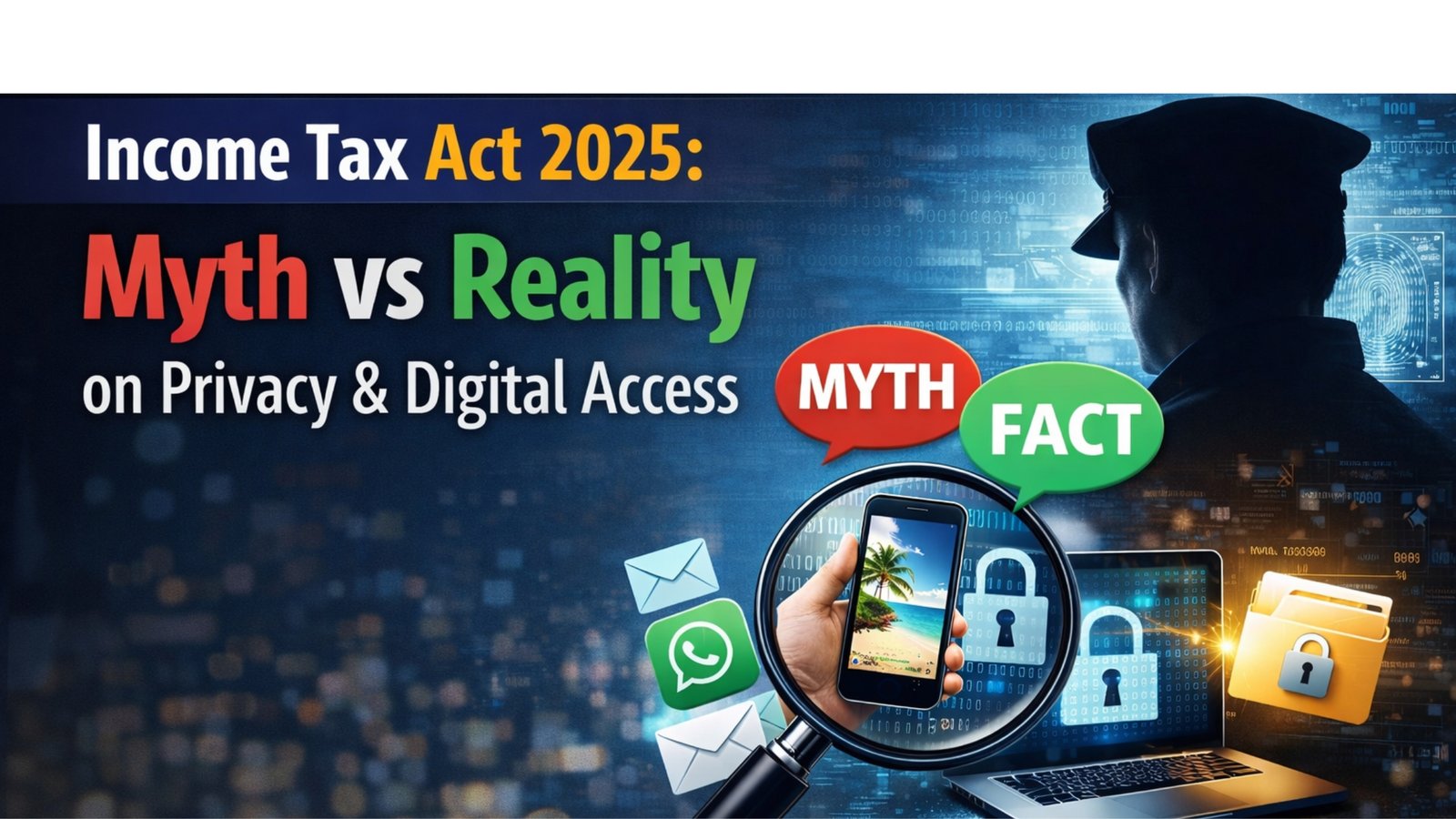
The suggested Income Tax Act 2025 has caused a commotion among taxpayers, entrepreneurs, and specialists. There has been a sense of constant dread at boardrooms and client meetings: Am I now afraid that tax officers now have access to my personal photos, videos, and WhatsApp chats?
The fear is actual. In the current digital era, we live in virtual space in most aspects of our personal and financial lives. But the law as perceived has been ahead of what the law is.
Important Implication: The majority of fears regarding the Income Tax Act 2025 are fallacies. The basic protection mechanisms are present.
The Income Tax Department has not been functioning without investigative authority. Tax officers have wide rights to:
These powers have changed with the economic and technological developments.
The move towards the digital records as opposed to the hardcopy books did not spare the tax law. Key developments include:
Court Acceptance of Digital Evidence:
What This Means: It is not a new practice that tax investigations are accessing digital data, as this has been occurring since a long time.
The most important legal prerequisite in any tax investigation is the requirement that there be a reason to believe that:
This is not just a formality. This has been highlighted in a variety of cases as a substantive protection.
Tax officers are not allowed to make random searches in the hope of discovering something. Investigations must be:
The legislation does not allow the random access to all information on the seized devices. The area of investigation directly correlates with the purpose of investigation.
Information that is illegally subject to examination:
Privacy has become a constitutional right in India. This serves as a constitutional limitation that investigative agencies should not infringe.
Key Rule: Although data may be stored in a device, it is not subject to a legal search unless that information is somehow related to the financial status of the taxpayer.
The new concept that is pointed to by the proposed framework is the virtual digital space.
This does not add any new powers- it only defines old ones.
Data storage today is radically different:
Past Situation: The officers were able to access such data but had problems with interpretation.
New Framework: It is stated in the law that when the information in digital and remote data repositories is financially relevant, they may be reviewed.
The Principle behind the Underlying is the same.
Relevance is still the determining factor. The fact that data is available does not imply that it could be legally examined.
The Modern Investigation Tools with What They Can Do.
Modern methods of digital forensics have enabled the officers to:
A very important distinction lies between:
Technology enhances the effectiveness of enforcement, but does not increase the scope of the law. Relevance, necessity, and proportionality are still in force.
The Indian courts have always served as a protection:
Taxpayers cannot be powerless. Any abuse to investigative powers can be contested by:
The situations that are under investigation.
In such cases, visual evidence can legitimately be a part of the investigations:
2. High-Value Transactions
3. Lifestyle Inconsistency
The analysis is done on its evidentiary value, rather than its personal nature. Law is about income, property, and observance, not spying on personal life.
The digital ecosystem brings more transparency and accountability, as opposed to surveillance.
Through transactions, communications and social media, your online history can be used to:
This doesn't mean:
Change the discussion on fear to readiness.
Focus clients on:
Proper Documentation
Accurate Reporting
Digital Hygiene
Substantiation
Practical Steps:
✓ Maintain a tidy financial record.
✓ Report all sources of income
✓ Maintain transaction documentation
✓ Check that your lifestyle is in line with stated income.
✓ Do not use informal or cash transactions.
✓ maintain records of major purchases.
Reality: They are not able to view any other photos but those related to your monetary matters. Personal images that have nothing to do with income or possessions are not exposed.
Reality: Constitutional rights to privacy and principles of relevance under the law remain. Protective measures have not been removed.
Fact: There have been years of digital access. The 2025 law is not the expansion of authority.
Reality: Courts are proactive in interfering with overreaching searches. The misuse can be contested in a legal manner.
These defences persist, in spite of technological progress:
"Reason to Believe" Requirement
Relevance Doctrine
Privacy Rights
Judicial Review
The changes are indicative of a shift towards:
The belief that Income Tax Act 2025 will allow unfettered, general access to private digital content is a major fallacy.
The basic principles of investigation are unchanged:
It is not the legal boundaries that are so clear, but rather the ease with which digital spaces are introduced into the legal framework, and the advanced tools that the authorities can use.
To professionals and taxpayers that comply with taxes:
The introduction of the Income Tax Act 2025 is not something to panic about, but instead an indication that the administration of tax is becoming more open and more technology-focused.
Uncertainty is best countered by informed knowledge. The professionals are expected to offer direction to the clients in a clear, balanced, and confident way.
Key Takeaways Summary
| Aspect | What's Changed | What Remains |
| Digital Access | Now explicitly stated | Still requires relevance |
| Data Types | Cloud & remote data recognized | Privacy protections intact |
| Investigation Tools | More sophisticated forensics | Legal standards unchanged |
| Taxpayer Protection | Clearer boundaries | Judicial review available |
Q1: Is it possible that tax officers can examine my personal photos?
A: Yes, only when they are pertinent to your financial matters. The personal pictures that do not refer to income or assets cannot be legally searched.
Q2 : Can authorities find my WhatsApp private even after they take my phone?
A: Yes, except in case of messages that have evidence of the financial transactions or unreported income. Conversations made privately are guarded.
Q3 : Should I panic over the changes made in 2025?
A: No. Obedient taxpayers need not be afraid, but report and record correctly.
Q4 : Are random searches permitted by the officers?
A: No. They must have a reason to believe that there is evaded taxation. No fishing expeditions are allowed.
Q5 : What shall I do to keep safe?
A: Keep good records, disclose income correctly, do not transact informally and be consistent in your reporting.
Disclaimer
This website is intended to provide information and education (in general) to the reader and should not be regarded as advice on any issue, including legal advice, tax advice, or compliance advice. Legal requirements, notifications and tax laws may change. Readers should seek professional advice from a qualified professional for a thorough understanding of their own situation or check the latest legal amendments on the government websites.
Book My Accountant (BMA) provides professional services; however, this document's content is not intended to be a substitute for BMA's personal advisory services.



"*" indicates required fields


